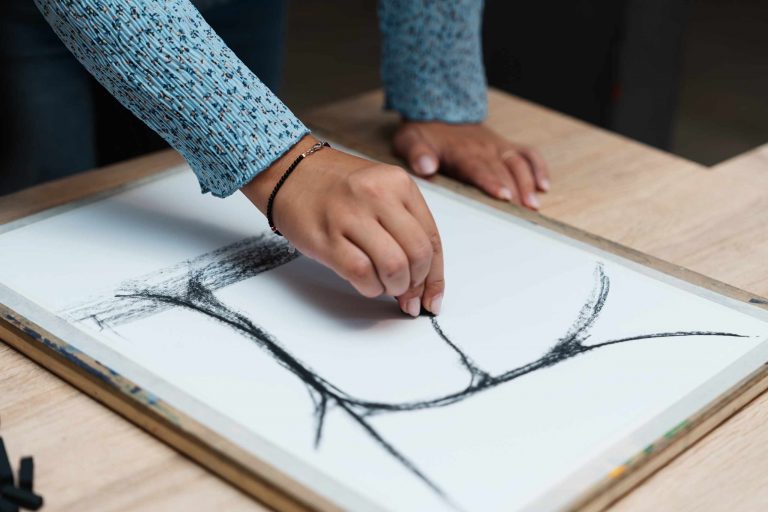
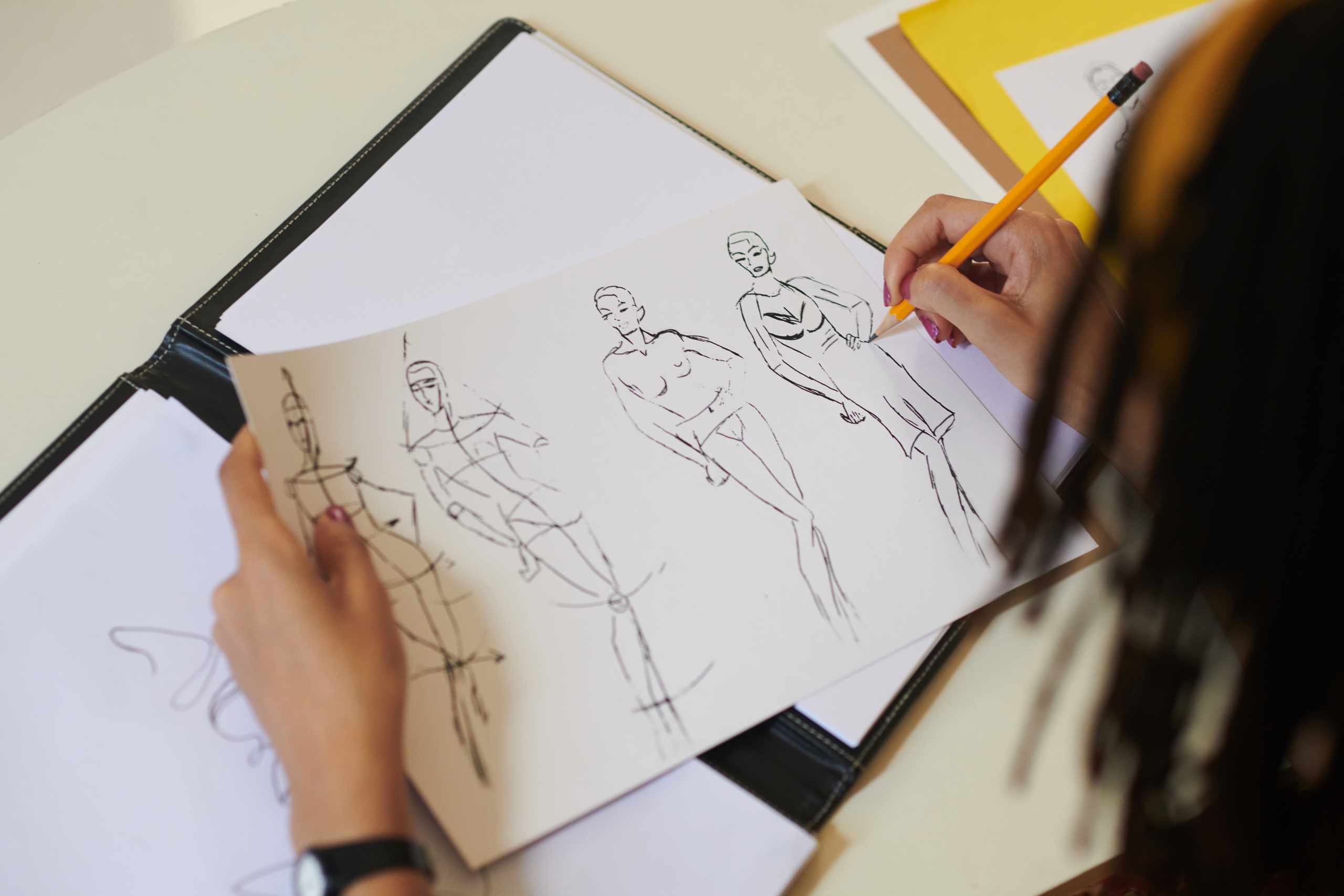
Light construction lines are helpful since you can experiment with the drawing first. The initial strokes do not have to show every contour you see. When drawing a mug, a bottle, a book, a chair, etc., you can sketch in the width, height, angle, and location of the object. A softly drawn box may stand for the body of a book, or a cylinder could hold the shape of a cup. As long as you make the first shapes pale and simple, you will not end up with a mess of graphite.
What often happens is that the construction lines end up just as dark as the outlines you want. This is what happens when you press hard with a graphite or mechanical pencil. Every mistake becomes harder to correct, and if you draw a lot of short strokes along a single edge, it ends up looking fuzzy. So apply less pressure to the pencil. Think of the first lines as temporary guides. When necessary, draw through forms and even parts of forms that would normally be hidden in the finished drawing. For instance, a soft ellipse through the top of a cup will help you think of the entire circle, even though some of the ellipse will be hidden by the rim in the final drawing.
Here is a simple exercise. Take a common object, like a bottle, a mug, or a box. On one sheet of paper, draw the object three times. First, draw the large construction shapes. Then, repeat those shapes, checking to make sure you have the correct proportions, angles, and locations. Finally, repeat the construction shapes one last time, and make all of the contours that are visible on the object darker. If you do this with the same object, you will easily be able to tell if your lines are becoming paler, simpler, and more focused.
Another way to keep the construction lines light is to avoid drawing everything right away. You do not need to sketch every break in the outline, every label, seam, highlight, handle, or texture. Wait to draw these elements until you know how the rest of the object is shaped. Instead, focus on the negative space and major lines of the object, and compare these to horizontal and vertical lines. Is the bottle tilted? Is one side of the box narrower due to perspective? These things are more important than a small detail. Fixing these problems now will save you much more time later than going back and correcting the entire drawing once it has been made too dark.
When you are sure the proportions look good, start to differentiate between construction lines and real contours. Make the lines darker only on the contours you want the viewer to notice. Where two lines overlap, make that line darker. Construction lines within the form of the object should remain light. If you add shading or hatch marks, do so in a way that does not interfere with the construction lines beneath them. The aim is not to make the drawing free of construction lines. You might still be able to see some faint construction lines in the final drawing. Just as long as they do not confuse the viewer, and the final contour is clear and unambiguous, you will be fine.
Before you call your drawing finished, look at it from a little distance. The object should be obvious before you try to read the small details. If the first thing you notice is the smudge of dark corrections, your construction lines were too dark. If you notice the shape of the object, and the construction lines appear behind the final contour, then your approach is working. This is a very important distinction to notice: the goal is not a clean drawing. It is a drawing where the initial thinking supports the final result.